Why Your Oven Not Getting To Temperature And How To Fix It
Your oven not getting to temperature can ruin meals and waste energy. This guide explains the common causes, from a faulty heating element to a broken thermostat, and gives you step-by-step fixes you can do yourself. Learn how to diagnose the problem and get your oven back to the right heat.
You preheat the oven, set the dial to 375°F, and wait. Ten minutes later, you slide in a tray of cookies. They come out pale, doughy, and undercooked. The oven not getting to temperature is one of the most frustrating kitchen problems. It wastes food, wastes energy, and makes you doubt your favorite recipes.
The good news is that you do not need to be a repair expert to solve this. Most causes are simple to spot and fix. This guide walks you through every reason your oven might be running cold, shows you how to test each part, and gives you clear steps to get the heat back on. I will also share quick tips and common mistakes so you can avoid the same headache again.
Whether you have a gas range or an electric oven, the principles are the same. Let us start with the top causes and work our way to a solution.
Key Takeaways
- Faulty heating element: The most common reason an oven not getting to temperature is a burned-out bake or broil element.
- Thermostat or sensor failure: A broken temperature sensor or thermostat can send wrong readings, leading to uneven baking.
- Calibration issues: Many ovens drift over time and can be recalibrated in minutes with no tools.
- Thermal fuse blows: A tripped thermal fuse cuts power to the heating system entirely.
- Convection fan problems: A stuck fan can create cold spots and long bake times.
- Know when to call a pro: Control board or wiring repairs are best left to a qualified technician.
📑 Table of Contents
Why Your Oven Not Getting To Temperature?
When an oven not getting to temperature, the root cause almost always falls into one of five categories. These are the parts and settings that control heat. Understanding them helps you narrow down the problem fast.
Here are the main reasons your oven temperature is off:
- Heating element failure: The bake element on the bottom or the broil element on the top can burn out. If one is dead, the oven will not reach the set temperature.
- Thermostat or temperature sensor fault: The sensor measures the heat and tells the control board when to turn the element on or off. A bad sensor gives wrong readings.
- Calibration drift: Over time, the oven dial can become inaccurate. It might say 350°F but only heat to 320°F.
- Thermal fuse blown: This safety part cuts power if the oven overheats. Once it blows, the heating circuit is broken.
- Control board issues: The brain of the oven can fail, preventing it from sending power to the elements.
Each of these problems has clear signs. I will break them down so you can match what you see to the fix.
Faulty Heating Element
The bake element is the metal coil at the bottom of the oven. During a preheat, it glows red when it is working. If you do not see any glow, or if you spot visible holes or blisters, the element has failed. A broken element means the oven not getting to temperature from the bottom. Food stays raw on the lower rack while the top might get some heat from the broil element.
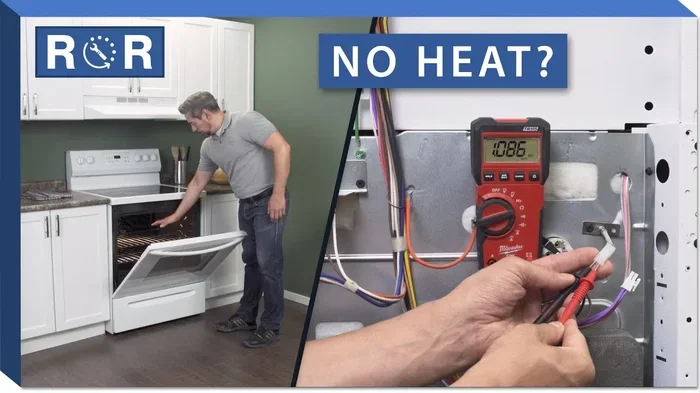
To test it, you can use a multimeter set to resistance. Unplug the oven, pull the element out, and touch the probes to the terminals. A good element reads between 20 and 40 ohms. No reading means the element is open and needs replacement.
Broken Thermostat or Temperature Sensor
Most modern ovens use a temperature sensor, a thin metal rod that extends into the oven cavity. It works with the thermostat to regulate heat. If the sensor is corroded, bent, or broken, the oven might overheat or underheat. You may notice that your oven preheats fine but then drops temperature when you open the door, or that it never reaches the target at all.
A quick test is to check the sensor with a multimeter. At room temperature, it should read around 1,000 to 1,100 ohms. If the reading is way off, the sensor is the culprit.
Calibration Issues
Even if all parts are working, the oven dial can be off by 25°F or more. This is a calibration problem. You might not notice it when roasting meat, but it can ruin delicate bakes like soufflés or pastries. An oven that consistently runs 20 degrees low is a common reason for oven temperature problems.
The fix is usually simple. Many ovens have a calibration screw behind the temperature knob. Turning it adjusts the offset. Some models let you recalibrate through the digital control panel. I will cover the exact steps in the fixes section.
Thermal Fuse Blown
The thermal fuse is a one-time safety device. If the oven overheats due to a faulty sensor or blocked vent, the fuse blows and cuts all power to the heating elements. Once blown, it cannot be reset. You must replace it. This is a less common cause but important to check if the oven is completely dead.
Control Board Failure
The control board receives input from the temperature sensor and switches the elements on and off. If the board fails, the oven might not heat at all or might heat erratically. This is a more advanced repair and often requires a professional.
How to Diagnose the Problem Yourself
Before you order parts, you need to know exactly what is wrong. A few simple tests can pinpoint the issue in under 30 minutes. Here is how to diagnose an oven not getting to temperature.
Visual Inspection
Start with the oven cold and unplugged. Look at the bake element and broil element. Do you see any bright spots, cracks, or holes? Does the element glow evenly when you turn on the oven to broil? A bright spot on one side means the element is partially burned out. No glow at all means it is dead.
Next, look at the temperature sensor. It is usually a metal rod near the back wall. Check for heavy corrosion or damage. A clean sensor should be shiny silver. If it looks crusty or blackened, it may be giving false readings.
Use a Multimeter to Test Parts
A multimeter is the best tool for an oven not heating. It measures electrical continuity and resistance. Here is the basic process:
- Unplug the oven or turn off the breaker.
- Locate the bake element terminals (usually at the back).
- Set the multimeter to the ohms setting.
- Touch the probes to the element terminals.
- Read the resistance. A working element shows continuity (a number between 20 and 40 ohms).
- Repeat for the temperature sensor and the thermal fuse.
If you get no continuity on the element or sensor, that part is bad. If the thermal fuse shows no continuity, it has blown.
Check the Thermal Fuse
The thermal fuse is usually located near the top of the oven cavity or on the back wall. It has two wires. Test it with the multimeter. If it shows no continuity, replace it. Always replace the fuse with the exact same rating.
| Symptom | Likely Cause | DIY Fix? |
|---|---|---|
| No heat at all | Blown thermal fuse or dead bake element | Yes, if you replace the part |
| Oven not getting to temperature (low) | Faulty temperature sensor or calibration | Yes, recalibrate or replace sensor |
| Uneven heating or cold spots | Bad convection fan or partial element failure | Yes, clean fan or replace element |
| Oven overheats and trips | Failed temperature sensor or thermal fuse | Replace sensor or fuse |
| Error code on display | Control board or sensor fault | Check manual, may need pro |
Step-by-Step Fixes You Can Do at Home
Once you know the cause, you can often fix it yourself. Here are the most common repairs for an oven not getting to temperature. I will walk you through each one safely.
Replacing the Heating Element
If the bake element is burned out, replacement is straightforward. You need a compatible part for your oven model. Here is how to do it:
- Unplug the oven or turn off the breaker.
- Remove the screws that hold the element to the back wall.
- Pull the element forward carefully. Do not touch the hot spots.
- Disconnect the wiring by pulling the connectors straight out.
- Connect the new element the same way.
- Secure it with screws and plug the oven back in.
- Test it by setting the oven to 350°F and checking for glow.
This fix usually takes 20 minutes and costs under $50 for the part. Always make sure the oven is completely disconnected from power before you start.
Recalibrating the Oven Thermostat
If your oven is consistently off by a few degrees, recalibration can fix the problem. The method depends on your oven type.
For ovens with a digital display:
- Press the “Bake” button.
- Hold the “Up” or “Down” arrow to adjust the temperature offset.
- Some ovens let you adjust in 1°F or 5°F increments.
- Save the setting and test with an oven thermometer.
For ovens with a dial knob:
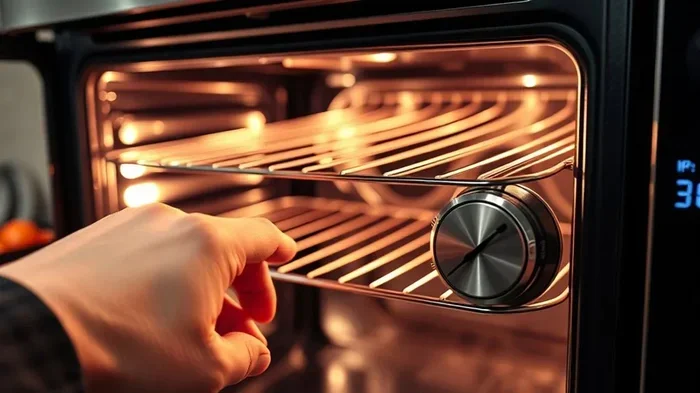
- Remove the temperature knob.
- Look for a small screw on the back of the knob or the thermostat body.
- Turn the screw clockwise to increase the temperature reading, counterclockwise to decrease it.
- Turn it a quarter turn at a time and test.
Quick Tip: Place a standalone oven thermometer on the center rack. Run the oven to 350°F and compare the thermometer reading to the dial. This tells you exactly how much adjustment you need.
Replacing the Temperature Sensor
A bad temperature sensor can cause the oven not getting to temperature or erratic heating. To replace it:
- Unplug the oven.
- Locate the sensor at the back of the oven cavity.
- Remove the screw or bracket holding it.
- Pull the sensor out and disconnect the wires.
- Connect the new sensor and secure it.
- Plug the oven back in and test.
This part usually costs between $20 and $60. The repair is simple and does not require advanced electrical skills.
When to Call a Professional for Oven Repair
Not all fixes are safe for a DIYer. Some problems require a trained technician. Here are signs you should call a pro:
- Control board failure: If the oven display is blank, shows error codes, or does not respond to buttons, the control board may be dead. Replacing it involves advanced wiring and programming.
- Wiring issues: If you smell burning plastic or see scorched wires, do not attempt to fix it yourself. Electrical faults can cause fires.
- Gas oven igniter problems: A gas oven that does not light may have a faulty igniter or gas valve. Gas repairs must be handled by a licensed professional.
- Repeated part failures: If you replace the heating element and it blows again quickly, there may be a deeper electrical issue in the oven that needs diagnosis.
Always check your warranty before scheduling a repair. A professional can also confirm the diagnosis if you are unsure.
Preventive Maintenance to Keep Your Oven Running Right
The best way to avoid an oven not getting to temperature is regular care. A few simple habits can extend the life of your oven and keep it baking evenly.
Regular Cleaning and Care
Food spills and grease can block vents, insulate heating elements, and cause uneven heat. Clean the oven interior at least once a month. Use a mild degreaser and a soft cloth. Avoid abrasive scouring pads that can damage the heating element coating.
For the temperature sensor, gently wipe it with a damp cloth. Never use harsh chemicals on the sensor. Keep the oven racks clean so air can circulate freely. This reduces cold spots and helps the oven preheat faster.
Know When to Replace Your Oven
If your oven is over 15 years old and needs frequent repairs, it may be more cost-effective to replace it. Modern ovens are more energy-efficient and often have better temperature accuracy. Look for signs like a consistently inaccurate temperature gauge, visible rust inside the cavity, or a control board that fails repeatedly. A new oven can save you money on energy bills and prevent the frustration of an oven not heating properly.
Expert Insight: According to appliance repair technicians, the most common mistake homeowners make is ignoring early warning signs. If your oven takes longer than usual to preheat or you notice uneven browning, test the temperature with a standalone thermometer right away. Catching a small problem early can prevent a full heating failure.
Conclusion
An oven not getting to temperature is a solvable problem. The most common causes are a burned-out heating element, a faulty temperature sensor, or a simple calibration drift. With a multimeter and a few basic tools, you can diagnose and fix most issues yourself. If the problem is a blown thermal fuse or control board, it is time to call a professional.
Start with the quick visual inspection and the oven thermometer test. These two steps will point you in the right direction. From there, follow the step-by-step fixes I shared. You will save money, avoid food waste, and get your oven back to baking at the right temperature. A little attention now keeps your oven running right for years to come.
Frequently Asked Questions
Why does my oven preheat but not reach the set temperature?
This usually means the bake element is partially burned out or the temperature sensor is failing. The element can glow but not produce enough heat. Test the element with a multimeter and check the sensor resistance to confirm the cause.
Can I use my oven if it is not getting to the right temperature?
You can, but your food will not cook properly. Baked goods need precise heat, and meats may not reach a safe internal temperature. It is best to fix the problem before relying on the oven for cooking.
How do I know if my oven temperature sensor is bad?
Signs include long preheat times, uneven baking, or an oven that does not hold temperature. You can test the sensor with a multimeter. A reading far from 1,000 to 1,100 ohms at room temperature means the sensor needs replacement.
Is it safe to recalibrate an oven myself?
Yes, recalibrating an oven is safe and simple. Most ovens have a calibration screw behind the knob or a digital adjustment in the settings. Just use an oven thermometer to verify the fix after adjusting.
What causes a thermal fuse to blow?
A thermal fuse blows when the oven overheats. This can happen if the temperature sensor fails, the ventilation is blocked, or the control board malfunctions. Once blown, the fuse must be replaced with an identical rating.
How much does it cost to fix an oven not getting to temperature?
DIY repairs like replacing a heating element or sensor cost $20 to $60 for parts. Professional repairs for a control board or wiring can range from $150 to $400 depending on the model and the labor rate in your area.